产品
植物真菌ELISA检测系列
抗体系列
植物病毒ELISA检测系列
食品安全检测系列
植物细菌ELISA检测系列
其他产品
丁香假单胞菌黄瓜致病变种 (Psl) - DAS ELISA 检测试剂盒
Cat#:B279
Specification:
| Catalog | Components | Quantity |
| B279-C1 | Coating Antibody | 500 |
| B279-C2 | Coating Antibody | 1000 |
| B279-C3 | Coating Antibody | 5000 |
| B279-D1 | Detecting conjugate, Alkaline Phosphatase | 500 |
| B279-D2 | Detecting conjugate, Alkaline Phosphatase | 1000 |
| B279-D3 | Detecting conjugate, Alkaline Phosphatase | 5000 |
| B279-K1 | ELISA Kit | 500 |
| B279-K2 | ELISA Kit | 1000 |
| B279-N1 | Negative control | 18 |
| B279-P2 | Positive control | 18 |
| B279-R1 | ELISA Reagents, Alkaline Phosphatase | 500 |
| B279-R2 | ELISA Reagents, Alkaline Phosphatase | 1000 |
| B279-R3 | ELISA Reagents, Alkaline Phosphatase | 5000 |
| B279-R4 | ELISA Reagents, Alkaline Phosphatase | 100 |
|
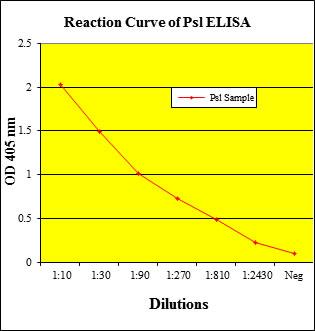
Genus: Pseudomonas Main host plants and diseases: Angular leaf spot, caused by the bacterium Pseudomonas syringae pv. lachrymans, is most severe on cucumber, zucchini squash, and honeydew melon. it also can infect muskmelon, cantaloupe, watermelon, other squashes, pumpkin, and various gourds. Transmission: The Pseudomonas bacterium is a seedborne pathogen. Sensitivity: Sensitivity of the ELISA is high. The bacteria can be consistently detected in infected plant tissues diluted at 1:270 - 810. Reactivity: Reaction of the ELISA is strong. Optical Density at 405nm is in a range of 0.750 – 2.100. depending on the bacterial titer in the samples tested. Specificity: This test system has no cross reaction with healthy plant tissues tested. Background is very low on the negative control wells. |
 |