产品
植物真菌ELISA检测系列
抗体系列
植物病毒ELISA检测系列
食品安全检测系列
植物细菌ELISA检测系列
其他产品
柄锈菌属 (Phak) - TAS ELISA 检测试剂盒
Cat#:F240
| Catalog | Components | Quantity |
| F240-C1 | Coating Antibody | 500 |
| F240-C2 | Coating Antibody | 1000 |
| F240-C3 | Coating Antibody | 5000 |
| F240-D1 | Detecting conjugate, Alkaline Phosphatase | 500 |
| F240-D2 | Detecting conjugate, Alkaline Phosphatase | 1000 |
| F240-D3 | Detecting conjugate, Alkaline Phosphatase | 5000 |
| F240-K1 | ELISA Kit | 500 |
| F240-K2 | ELISA Kit | 1000 |
| F240-N1 | Negative control | 18 |
| F240-P2 | Positive control | 18 |
| F240-R1 | ELISA Reagents, Alkaline Phosphatase | 500 |
| F240-R2 | ELISA Reagents, Alkaline Phosphatase | 1000 |
| F240-R3 | ELISA Reagents, Alkaline Phosphatase | 5000 |
| F240-R4 | ELISA Reagents, Alkaline Phosphatase | 100 |
|
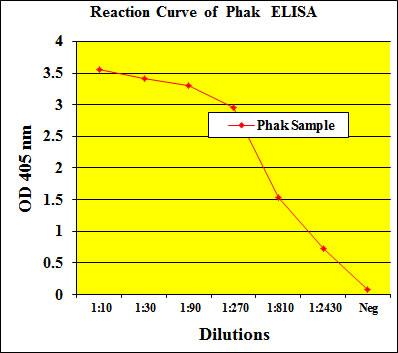
Sensitivity: This ELISA is very sensitive, and can detect ASR/SR fungi in pre‐symptomatic plant leaves. The ASR/SR pathogen can be detected at dilution of 1:21870 for the plant leaf samples prepared at 14 days after infection, and at dilution of 1:270 for the plant leaf samples prepared at 5 days after infection. Reactivity: This ELISA reacts with P. pachyrhizi and P. meibomiae fungal species. The assay detected the isolates of P. pachyrhizi and P. meibomiae ininfected host plants such as soybean and lima bean. Reaction of this test is very strong. Optical Density at 405nm is in a range of 2.000 - >3.000 depending on the fungal titers in the samples tested. Specificity: This test system is genius‐specific for Phakopsora, and reacts with both species of P. pachyrhizi (ASR) and P.meibomiae (SR). The antibodies used in this ELISA have high specificity to both r369 and r107 proteins. This assay does not react with the other related rust fungi or any of the soybeanpathogens tested, including Uromyces appendisulatus, Puccinia punctiformis, Puccinia graminis, Puccinia graminis tritici, Rose rust, Fusarium graminearum, Downy mildew, Pseudomonas syringae , Pseudomonas syringae pv. phaseolicola, Xanthomonas campestris pv. glycine, Ustilago tritici, Erysiphae polygono DC, Septoria lycopersici and Cercospora sojina. There is no cross reaction with healthy plant tissues. Background is very low on all of the negative control wells. |
 |